Sunday, 12 April 2015

The Institute and Anthony Trollope


With the literary world about to celebrate Anthony Trollope's 200th anniversary (he was born on 24 April 1815) it is timely to recall his extended stay in Australia in 1871-72, and the colonial response to the man described by Nigel Starck as Australia’s "first visiting celebrity in popular culture."(1)

A selection of Trollope's works from the Institute collection

Trollope visited all of the colonies during his year and two days sojourn, and spent time in Tasmania in January and February 1872. Coverage of the visit in the local press is a curious mixture of adulation tempered by a fear that he might take away with him an unfavourable impression.
To illustrate, here is a report from The Mercury (Monday 29 Jan 1872, p3) of a short speech Trollope made in Hobart;

Mr. Trollope accepted an invitation to be present at a banquet given to the Hon. Mr. Dunn at the Town Hall, and in his response to the toast of his health, Mr. Trollope gave, in a few words, the impressions he had received of us from a few days' sojourn in the South. He said:-"Perhaps, as a stranger, you will expect that I should say something about the things I have met in this and the other colonies, (Yes, yes.) I did not come among you to teach you, but rather to learn something from you. (Cheers.) I did not come to tell you what I thought but to learn what you think; but on such an occasion as this, and after the speeches we have heard, I cannot refrain from making a few remarks. I think your position here is a happy one. You are placed in a colony having everything around you to make life happy. Your genial climate and fertile soil produce everything tending to promote good spirits, and you are surrounded by everything God can give to please man. (Cheers.) I find, however, you have one terrible drawback-a drawback sufficient to destroy all your happiness. You all think you have been ruined. I find that is the common expression of every gentleman who speaks to me of Tasmania. Every gentleman speaks to me of the loveliness of the climate, the beauty of the scenery, all that promotes happiness, but still he considers the colony has been ruined. The army has been removed, and with it some £350,000 of British expenditure has been withdrawn, and the colony ruined. I speak tenderly on this point, knowing I may tread on some one's corns, but I believe that the colony has been blessed by the withdrawal of the army. In my opinion the withdrawal of the army was one of the greatest blessings that ever occurred to the colony. You have chosen to take upon you like men the work of independent self-government. You have chosen to say you won't be servants or bondmen, even of the mother country (cheers); and yet you complain that the mother country has withdrawn the army, and ruined the colony by so doing. Being independent you carry on a government of your own, have Ministers of your own; being beholden to the mother country for nothing but allegiance, surely you do not want a body of 200 men of the mother country's army merely to show you the beauties of a red coat. Gentlemen, I find you live in happiness and plenty, with every prospect of success..."

The Mercury spends the balance of its report mounting a counter-argument and attempting to justify the colonists' position.

One wonders how often since that speech have these two contradictory positions been simultaneously held in Tasmania – that we live in the best place on earth and that we are totally ruined?

Looking over the shelves of the Launceston Mechanics' Institute collection, it is clear that Trollope was a favoured author, and that his works were well-read. All of his major works are held, including the Palliser novels and the Chronicles of Barsetshire, many in early editions. There are three copies of Orley Farm, all dated 1862 and including a second printing. Trollope's Autobiography (1883) is held, in a hybrid set of first (vol I) and second (vol II) editions. There are first editions of The Claverings (1867) and of North America (1862).

Frontispiece from Orley Farm. Illustration by John Everett Millais
But the Institute had an even closer encounter with the great writer when he visited Launceston in the party of the Governor during Launceston Cup week of 1872. The group arrived late in the evening on 5 February, and their itinerary included a visit to the Chudleigh caves and Corra Linn as well as attendance at the race meeting. The Governor and "his suite" also attended a concert at the Mechanics' Institute given by the Carrandinis.

It would seem that the Board of Management decided to invite Trollope to visit the Institute because among their correspondence is a brief note from the author to William Wathen (Institute Secretary from 1860-1900) regretfully declining. They may not have got their man, but they did at least obtain his autograph.
Anthony Trollope's letter to William Wathen


(1) Dr Starck has retraced Trollope's visit to the colonies in a recently published book The First Celebrity: Anthony Trollope’s Australasian odyssey (Lansdowne Media)

Thursday, 2 April 2015

Publications of the Institute


Reference has been made previously to publications of the Launceston Mechanics' Institute, most notably its Jubilee History by Ernest Whitfeld (1892) and of course the Printed Catalogues and Annual Reports issued over many years.

At least five lectures given at the Institute are known to have been issued in printed form;

West, John, The fine arts: a lecture, delivered at the request of the Committee of the Launceston Mechanics' Institute; (Launceston : Printed at the Examiner Office, 1848.)


Price, Charles, The intellectual improvement of the working classes: a lecture delivered at the Launceston Mechanics' Institute, April 4th, 1850..[Launceston, Van Diemen's Land :s.n.,c1850 printing : (Launceston :J.S. Waddell)          


Ewing, Robert Kirkwood, Lecture replying to objections against phrenology, delivered at the Mechanics' Institution, on Thursday, Sept. 16, 1852. Launceston: Henry Dowling, c1852.     


Aikenhead, James, 1815-1887, Principles of political economy, Launceston : The Author, 1856 (Launceston : J.S. Waddell, Examiner)


Cheek, J. W., Protection: as it affects the farming industry of Tasmania : A lecture delivered ... at the Mechanics Institute, Launceston ... Nov. 1st, (Launceston :National Protection Assn. of Tasmania, c1888.)      

All of these pamphlets are now very rare, as is the most ambitious publication undertaken by  the Institute; 

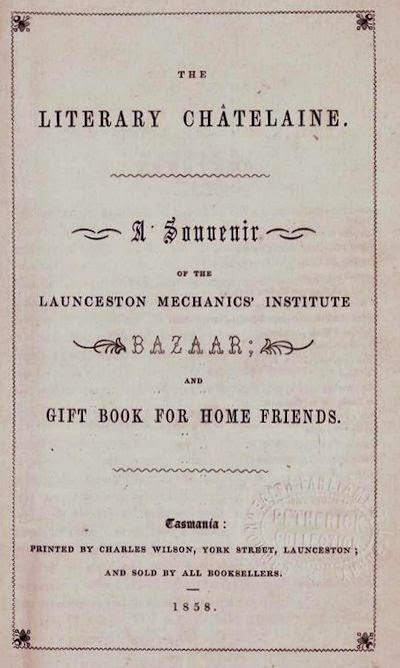
The LITERARY CHATELAINE : a Souvenir of the Launceston Mechanics Institute Bazaar, and Gift Book for home friends. Tasmania: printed by Charles Wilson, York-street, Launceston, 1858.

Among the identified contributors were William Carr Boyd and Samuel Prout Hill, but most contributors chose to offer their work under noms-de-plume, such as 'Châtelar', 'Silenzio' and 'Juvenis'. The image below, of the title page, was sourced from the National Library's copy in the Petherick Collection.


Revenue from sales of the Literary Chatelaine went to fundraising for the Institute's building. The following review of the publication from the Launceston Examiner (2 Mar 1858, p2) gives some idea of the character of this unusual collection;


REVIEW. We have received a copy of this little book. It is called in the preface "a collection of trifles." We are told that the name is derived from the chain which the ladies of castles in the middle ages used to suspend the household keys, &c., but which modern ladies employ for more fanciful and ornamental purposes; and the editors wish that the book thus named "should partake of the characteristics of both bygone and present Chatelaines,"-the special merit being that the articles are "all of genuine Tasmanian workmanship." The circumstances under which the book is produced, and its modest pretensions as an essay in the comparatively untried field of Tasmanian literature, must, to a certain extent, disarm criticism. The labors of the editors in selection must have been long and arduous, for out of the contributions sent, which appear to have been more than sixty, only twenty, or one-third, are inserted. Seven pages are taken up with "answers to correspondents" and many of the contributions have furnished the editors with an excuse for some severe though probably just remarks. ... After reading them, and the editors' comments, the suppression of the rest will please all but the authors. Perhaps, however, it would have been better to have said nothing about the rejected pieces. Their authors will hardly derive much consolation from the assurance that "with a little more practice they will write remarkably well," and we fancy the editors themselves will be disappointed in the "hope to hear from them again next year."

This fascinating miscellany has been digitised and may be viewed through the National Library of Australia's Trove discovery service.

Another LMI publication, or at least a proposed publication, is currently a mystery. Between September 1844 and May 1845, the advertisement below appeared in the Launceston Examiner.

It appears that the book may never have been published, perhaps because the subscriber's list was not filled. However it is especially interesting that the Institute, in its very early days, would have considered undertaking such an ambitious project; and one so closely aligned to its educational objectives.

The Friends of the Launceston Mechanics' Institute are endeavouring to obtain copies of all LMI publications, including its printed catalogues, and indeed any ephemera such as member's tickets, invitations to events and admission tickets. Donations of any such material relating to the Institute would be most gratefully received.

Monday, 23 March 2015

Memories of the Launceston Mechanics’ Institute


 Contributed by Catherine Pearce

In 1857 my great grandfather John Joyce donated a modest sum of money to the Launceston Mechanics’ Institute building fund.  Much later he became a member of its Board of Management. The son of a convict, he rose from humble origins to become a prosperous butcher and prominent citizen.  His support of the Mechanics’ Institute signalled that he and his family had shrugged off the stain of convictism, that they were both affluent and respectable.  Likewise, the new Mechanics Institute building would demonstrate that Launceston was civilised and cultured, that it was leaving its dubious past behind.

As the great granddaughter of a man who supported the Institute at its inception, and as a librarian myself, I feel very sad that the old Institute building, the product of a community fund-raising effort described as “one of the great achievements in Australian regional history”(1),   was demolished in the 1970s. The collection is all that remains, a testament to the pride and hard work of a pioneer community. 

From an exhibition organised by Catherine Pearce in 2012 to celebrate the 170th anniversary of the Institute
I can just recall visiting the old Institute building, by then the Launceston Public Library, as a very small child in the 1960s.  We lived on a farm at Winkleigh.  My father was a great reader, so the family’s weekly visit to Launceston often included a trip to the library.  I remember standing by a towering wooden counter above which I could just see the top of the Librarian’s head as she stamped our books. I don’t recall my father’s choices, perhaps war stories or something by Wyndham or Asimov. I was a fairy tale addict. I remain an avid reader to this day.

An earlier (1928) view of the library counter from a photograph by Charles Burrows


(1) Stefan Petrow, Going to the Mechanics: a history of the Launceston Mechanics’ Institute, 1842-1914, Historical Survey of Northern Tasmania, 1998, p.34

Sunday, 15 March 2015

Oldaker Family donations


Many donations of books to the Launceston Mechanics’ Institute were not isolated gifts. Several members of the Institute gave more than one book, either in one bequest or on many occasions over the years. In this respect the collection of books from the Oldaker family appears to be nothing particularly unusual; however, probably few donations would illustrate the history of a family as well as this small collection of five or six books.
All the books, apart from one Latin dictionary, are on the subject of agriculture and finance. As one would expect from a collection of practical books, they are well used, and owners have not hesitated to write not only their names in the front, but also notes (copious, in some cases) within the pages of the books and in the end papers.
The book with the earliest date written in it is also the one with the latest date, and spans one hundred and ten years of the Oldaker family, beginning with Charles Oldaker, born Stratford upon Avon in 1800 (later pioneer on Tasmania’s NW coast) and ending with his great-grandson, Max Oldaker, internationally renowned singer and stage performer.
Morell, Thomas. Abridgement of Ainsworth’s dictionary, English and Latin designed for the use of schools, London, 1808.
Inside the front cover is written “Charles Oldaker Stratford on Avon Warwickshire”, on the following page “Charles Oldaker Feby 3rd 1812” and “Max Oldaker Sept. 1st 1922”. Inside the back cover is “Charles Oldaker Stratford”. In the section at the back of the dictionary is a list “Nominum propriorum”; at the beginning of the “O” section “Oldaker” has been added in what appears to be Charles’ hand.
It is possible that some of the Oldaker books in the LMI collection belonged to Charles’ father, William. “William Oldaker, a Miller of Cleeve Prior, Worcestershire, and Meal Merchant of Stratford, became an important banker in Shakespeare’s birth-place”.[1]
Lowrie, William, The principles of keeping accounts with bankers… with accurate tables… London, Longman, Hurst, Rees and Orme, 1809.
Inside the cover is written “Charles Oldaker 1st June 1823. Stratford upon Avon”. Name and date are repeated on the title page. There are handwritten notes inside the back cover about regulation weights and measures for peas, beans and grains. This handwriting is slightly different from the signature in the front of the book.
Charles Oldaker and his brother, Edmund, became successful lawyers, operating a firm in nearby Pershore and in London.
Lawrence, Richard. An inquiry into the structure & animal oeconomy of the horse… Birmingham, Richard Lawrence publisher.
                Charles Oldaker. Pershore.”
This last book reflects Charles’ interest in farming. In Max Oldaker’s memoirs, he wrote that his great-grandfather Charles “had long imagined himself a land-owner, a leisured gentleman farmer …”[2] By 1838 it seems that Charles’ dream had come true; he retired from law and was able to purchase Hardres Court, an estate close to Canterbury in Kent.
Jarvis, Thomas. The Farmer’s harvest companion and country gentleman’s assistant… [Agriculturist’s ready reckoner]. Hythe, William Tiffen, 1836.
Chas. Oldaker Hardus Court 28th July 1838. Includes a handwritten “Table of Duties payable”. There is a handwritten note on p.190 “240 lbs make 1 Pack” – added to a section on wool weights. A stain on p. 32 looks very much like the rich red soil of the Tasmanian NW coast.


Charles Oldaker's handwritten table of duties payable
The “duties payable” and a general depression prompted Charles to migrate to Van Diemen’s Land with his wife, Emma, and young Francis and Emma in 1850. Charles’ two older sons, William Henry and Charles Ford from his first marriage, also accompanied them. Their life in Van Diemen’s Land began at once with great difficulties. Their ship, the ‘Phillip Oakden’ struck Hebe Reef on arrival in the Tamar estuary. Fortunately, for the passengers and for us, a lot of the cargo was saved. In the case of the Oldaker family, our small collection of books must have been amongst the items saved.
The horse; with a treatise on draught... London, Baldwin and Cradock, 1831.      
Contains a newspaper cutting on horse treatment. A slip of paper (wrapping paper?) with “Cornwall Chronicle” printed on it and the name “W Oldaker’ handwritten on it. There are at least two hands on several pieces of notepaper, one apparently Charles senior and one possibly William. One a recipe for Pink Linseed Oil balls, a remedy for scoured horse.
The next book is also not dated, but the handwriting in it includes that of Charles Edmund Wells Oldaker. Charles senior’s son, Francis Frederick Orson Oldaker married his second wife, Maria Ann Higgs in 1878 and their son, Charles Edmund Wells Oldaker was born in 1879. Maria Ann Higgs was the daughter of Joshua Higgs, architect, of ‘Arnwood’ near Torquay (East Devonport). Joshua Higgs was later to give the same name to his house in Trevallyn.
Youatt, W. Cattle, their breeds, management, and diseases. London, Baldwin and Cradock, 1834.
P. 486 et al marginalia, in the section on “diarrhoea and dysentery”. Childish handwriting inside the front cover includes letter writing practice and “C E W O” and “C Oldaker” [This would be Charles Edmund Wells Oldaker, Max Oldaker’s father.]
This collection of books from the Oldaker family made its way from Stratford upon Avon in 1812 to East Devonport at some time after 1879. At some point they became part of the collection of the Launceston Mechanics Institute. For anyone using the LMI collection now, the books can be seen as “snapshots” from the history of one of Northern Tasmania’s most well-known families.
Contributed by Sue McClarron

[1] Osborne, Charles, Max Oldaker; last of the matinee idols, London, Michael O’Mara Books Ltd, 1988, p. 3.
[2] Ibid, p.4.