Showing posts with label History. Show all posts

Friday, 8 May 2015

A Special Gift to the Institute


While trawling through the records of the Launceston Mechanics' Institute recently our assiduous FOLMI researcher Dorothy Rosemann discovered this intriguing letter from parliamentary librarian Arthur Wadsworth to our own librarian Joseph Forward.


The offer contained in the letter, a complete set of the Historical Records of Australia for the Institute, is remarkable enough given that Launceston was the only city outside the state capitals to receive a set. But the reasons given for the decision are even more surprising. Firstly, that Launceston "possessed independence of Hobart up to almost the middle of the [19th] century". Clearly this was not based on historical fact. Launceston's period of self-rule under a Lieutenant-Governor reporting directly to Sydney lasted a mere nine years, from 1804 to 1813, and from 1825, when VDL became an independent colony, Hobart was incontrovertibly the seat of government.

Wadsworth's second justification – that "the relation of Launceston to Hobart is different to that of any city in any other state to its capital" – was however quite true, remains true to this day, and would have been viewed as a badge of honour in 1920 in the "northern capital".

The man who carried these arguments to the Federal Parliament on behalf of the Institute was long-serving Tasmanian Senator, John Henry Keating, a member of the Parliamentary Library Committee and a fierce advocate for his state. It was Keating who convinced the Committee of Launceston's unique constitutional position and historical claim to special treatment.

Just three days after Wadsworth conveyed the Committee's decision to the Institute, the Senator wrote a letter headed "UNOFFICIAL" to Forward, setting out in detail the Committee's reasoning for the special treatment afforded to Launceston, pointing out that all similar requests had been turned down, and emphasising their reluctance to set a precedent which might be exploited by other regional cities and towns.

He then suggested a quid pro quo which he believed would absolutely seal the deal by removing any doubts that Launceston was a special case. When Dr Watson (compiler and editor of the Historical Records) had visited the Institute library in his search for early records he had "seen an extra copy or copies of the local issue of Pickwick Papers with locally drawn sketches." Keating concluded "I think perhaps the best course would be, if your Committee feels so disposed, that they should offer one of these Pickwick papers to the Library Committee of the Commonwealth through its Secretary. Such an action would be satisfactory in every way and would, I can assure you, be very much appreciated by the Library Committee as well as personally by yours faithfully J H Keating."

Senator Keating urged discretion in the matter and further suggested that it was desirable that the exchange should not come formally before the Institute's committee, nor be referred to in their minutes.

And so it was, presumably, that the Institute gave up one of their copies of Dowling's pirated edition of 'Pickwick Papers' and the Parliamentary Library gained a very desirable item through their own act of piracy – a gift with strings attached.

Today the original set of Historical Records of Australia is held in the local studies collection in Launceston's public library, along with two bound copies of Dowling's edition of 'Pickwick Papers' and an even rarer set of the original parts as issued in 1838-39.

Thursday, 2 April 2015

Publications of the Institute


Reference has been made previously to publications of the Launceston Mechanics' Institute, most notably its Jubilee History by Ernest Whitfeld (1892) and of course the Printed Catalogues and Annual Reports issued over many years.

At least five lectures given at the Institute are known to have been issued in printed form;

West, John, The fine arts: a lecture, delivered at the request of the Committee of the Launceston Mechanics' Institute; (Launceston : Printed at the Examiner Office, 1848.)


Price, Charles, The intellectual improvement of the working classes: a lecture delivered at the Launceston Mechanics' Institute, April 4th, 1850..[Launceston, Van Diemen's Land :s.n.,c1850 printing : (Launceston :J.S. Waddell)          


Ewing, Robert Kirkwood, Lecture replying to objections against phrenology, delivered at the Mechanics' Institution, on Thursday, Sept. 16, 1852. Launceston: Henry Dowling, c1852.     


Aikenhead, James, 1815-1887, Principles of political economy, Launceston : The Author, 1856 (Launceston : J.S. Waddell, Examiner)


Cheek, J. W., Protection: as it affects the farming industry of Tasmania : A lecture delivered ... at the Mechanics Institute, Launceston ... Nov. 1st, (Launceston :National Protection Assn. of Tasmania, c1888.)      

All of these pamphlets are now very rare, as is the most ambitious publication undertaken by  the Institute; 

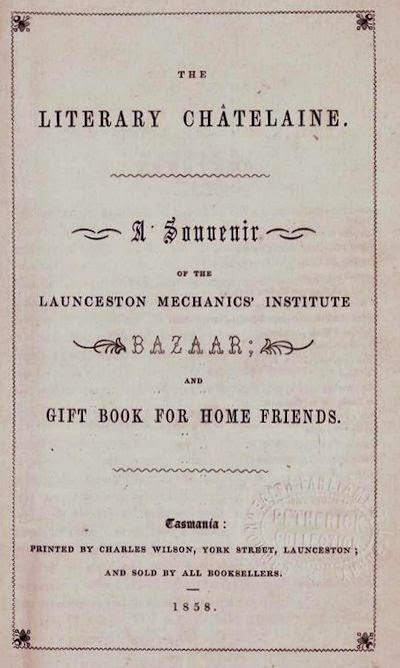
The LITERARY CHATELAINE : a Souvenir of the Launceston Mechanics Institute Bazaar, and Gift Book for home friends. Tasmania: printed by Charles Wilson, York-street, Launceston, 1858.

Among the identified contributors were William Carr Boyd and Samuel Prout Hill, but most contributors chose to offer their work under noms-de-plume, such as 'Châtelar', 'Silenzio' and 'Juvenis'. The image below, of the title page, was sourced from the National Library's copy in the Petherick Collection.


Revenue from sales of the Literary Chatelaine went to fundraising for the Institute's building. The following review of the publication from the Launceston Examiner (2 Mar 1858, p2) gives some idea of the character of this unusual collection;


REVIEW. We have received a copy of this little book. It is called in the preface "a collection of trifles." We are told that the name is derived from the chain which the ladies of castles in the middle ages used to suspend the household keys, &c., but which modern ladies employ for more fanciful and ornamental purposes; and the editors wish that the book thus named "should partake of the characteristics of both bygone and present Chatelaines,"-the special merit being that the articles are "all of genuine Tasmanian workmanship." The circumstances under which the book is produced, and its modest pretensions as an essay in the comparatively untried field of Tasmanian literature, must, to a certain extent, disarm criticism. The labors of the editors in selection must have been long and arduous, for out of the contributions sent, which appear to have been more than sixty, only twenty, or one-third, are inserted. Seven pages are taken up with "answers to correspondents" and many of the contributions have furnished the editors with an excuse for some severe though probably just remarks. ... After reading them, and the editors' comments, the suppression of the rest will please all but the authors. Perhaps, however, it would have been better to have said nothing about the rejected pieces. Their authors will hardly derive much consolation from the assurance that "with a little more practice they will write remarkably well," and we fancy the editors themselves will be disappointed in the "hope to hear from them again next year."

This fascinating miscellany has been digitised and may be viewed through the National Library of Australia's Trove discovery service.

Another LMI publication, or at least a proposed publication, is currently a mystery. Between September 1844 and May 1845, the advertisement below appeared in the Launceston Examiner.

It appears that the book may never have been published, perhaps because the subscriber's list was not filled. However it is especially interesting that the Institute, in its very early days, would have considered undertaking such an ambitious project; and one so closely aligned to its educational objectives.

The Friends of the Launceston Mechanics' Institute are endeavouring to obtain copies of all LMI publications, including its printed catalogues, and indeed any ephemera such as member's tickets, invitations to events and admission tickets. Donations of any such material relating to the Institute would be most gratefully received.

Monday, 23 March 2015

Memories of the Launceston Mechanics’ Institute


 Contributed by Catherine Pearce

In 1857 my great grandfather John Joyce donated a modest sum of money to the Launceston Mechanics’ Institute building fund.  Much later he became a member of its Board of Management. The son of a convict, he rose from humble origins to become a prosperous butcher and prominent citizen.  His support of the Mechanics’ Institute signalled that he and his family had shrugged off the stain of convictism, that they were both affluent and respectable.  Likewise, the new Mechanics Institute building would demonstrate that Launceston was civilised and cultured, that it was leaving its dubious past behind.

As the great granddaughter of a man who supported the Institute at its inception, and as a librarian myself, I feel very sad that the old Institute building, the product of a community fund-raising effort described as “one of the great achievements in Australian regional history”(1),   was demolished in the 1970s. The collection is all that remains, a testament to the pride and hard work of a pioneer community. 

From an exhibition organised by Catherine Pearce in 2012 to celebrate the 170th anniversary of the Institute
I can just recall visiting the old Institute building, by then the Launceston Public Library, as a very small child in the 1960s.  We lived on a farm at Winkleigh.  My father was a great reader, so the family’s weekly visit to Launceston often included a trip to the library.  I remember standing by a towering wooden counter above which I could just see the top of the Librarian’s head as she stamped our books. I don’t recall my father’s choices, perhaps war stories or something by Wyndham or Asimov. I was a fairy tale addict. I remain an avid reader to this day.

An earlier (1928) view of the library counter from a photograph by Charles Burrows


(1) Stefan Petrow, Going to the Mechanics: a history of the Launceston Mechanics’ Institute, 1842-1914, Historical Survey of Northern Tasmania, 1998, p.34

Wednesday, 28 May 2014

A Rival for the Institute


The Launceston Library Society was formed in 1845, just three years after the Mechanics' Institute first opened its doors. 

The Society's original intent was to rely on member subscriptions for the purchase of books, but in 1849  Government support was sought, and refused, as membership failed to grow.

The original bookplate of the Society from the Westminster Review, Vol 59, Jan 1853 - April 1855

By 1855 the Library's opening hours had been reduced to one hour per week.  In 1856 the members decided to "rebrand" the Society as the Launceston Public Library, and a government subsidy of one hundred pounds per annum was offered on condition that the reading room and library were opened to the public. 

The new bookplate - printed for the Society by Ashby & Co, London.

In 1861 further support was received in the form of accommodation in the Public Buildings in St John Street – directly opposite the Institute. Financial support was short-lived and was withdrawn in 1864, although an allocation of escheated funds in 1869 provided something of a reprieve. 

The President's comments on the inadequacy of the allocation were reported in the Launceston Examiner of 23 March 1872:

LAUNCESTON PUBLIC LIBRARY. ANNUAL MEETING. The annual meeting of subscribers to the Launceston Public Library, which had twice been adjourned owing to the absence of a quorum, was held on Thursday evening, the hon. James Aikenhead, Esq., M.L.C., in the chair. The attendance was very limited.
REPORT.
The following report was read- According to the rules of the Launceston Public Library the annual meeting should have been held  on the second Thursday in January, but for reasons which it would be difficult to defend the general  meeting of members has been postponed untill now.
The members are aware that some years ago, at the instance of the Government of the day, this Library collected by private means was thrown open to the public, daily, during certain hours, in consideration of a yearly grant of money. This, however, was soon withdrawn, and the committee consider unfairly. Although the Howells escheated property was in this town, nearly the whole of the proceeds of the sale, amounting to over £2,000, was given to the Hobart Town Public Library while only £200 was given the kindred institution at Launceston. It cannot, therefore, excite surprise that the Launceston Public Library has been seriously crippled, by which its usefulness has been greatly impaired. It is rather a matter of congratulation that it has been able to keep its doors open so long.
The Library contains between five and six thousand volumes, of which 1044 were issued during the year. In the same term 718 persons visited the library. The number of subscribers on the books is only 27, and the subscriptions for the year 25l. 5s. One indent of books has been transmitted to England during the year.
On this occasion it will be necessary that a president, treasurer, secretary, and committee of seven subscribers be elected. The financial statement showed a balance to credit of £17 14s 1d on 31st December last. The report and financial statement having been adopted, the following, officers for the ensuing year were elected - Mr J. Aikenhead, President; Mr A. M. Milligan, Treasurer;  Mr R. Green, junr., Secretary ; Executive Committee Messrs. W. S. Button, Henry Dowling, J. L. Miller, Charles Thompson, Adye Douglas, J. J. Hudson, and George Collins. A vote of thanks to the Chairman terminated the proceedings.

An Hobartian view of the Launceston Public Library, and a revealing insight to the rivalry between the cities is contained in this report from the Mercury of 30 March 1874;


Our Launceston letter
[From our correspondent]
I wandered into that unfamiliar institution known as the Launceston Public Library, this afternoon. This musty reading room, situate in a portion of the Public Buildings, and filled with antiquated literature and cobwebs, and only open at such hours as to practically exclude the general public from any participation in its benefits, has not for some time previous attracted so large an attendance as assembled today. All the savants of the North, and a great many of the ordinary public were there, bent on seeing the preserved salmon for some time exhibited in the Museum at Hobart Town, and for which the sum of £30 was paid. With thoughtful consideration the specimen has been sent by the authorities for temporary exhibition here, and is, I believe, to remain on view for some days. I do not affect to be a connoiseur, and fully confess my inability to decide as to the bona fides of his Salmonship. I must, however, acknowledge some astonishment at witnessing among some of the spectators assembled, whose knowledge I am sure on this subject can be little superior to my own, an assumption of wisdom somewhat inexplicable. Many of these gentlemen have never yet been out of Tasmania, but with ominous head shaking, expressed their conviction that this was not the real simon pure. This peculiarly is not altogether difficult to account for. The mere fact that the finny specimen has been pronounced by competent authorities at Hobart Town to be a real salmo salar, is quite sufficient reason for competent or incompetent authority at Launceston to pronounce it a salmo trutta !

Later the Government decided it could no longer provide accommodation for the Library, which was moved to the Town Hall. In 1881 the books of the Library were placed into storage at the Town Hall and the Library ceased operations.

As early as 1863 the rival Launceston Mechanics Institute had unsuccessfully proposed a merger with the Library Society, but in 1888 the Society finally determined to hand over the Launceston Public Library collection, then some 2000 volumes, as well as the assets of the Society to the Institute, on condition of the provision of a  free public reading room. The Institute accepted the gift and asked Parliament to enable it to alter its title so as to include the words, "and public library," and in November, 1890, an Act of Incorporation was passed confirming the new name.

The provision of  a Reading Room was a boon to the Institute,  and was facilitated by the opening of the new Museum, and the consequent removal of the exhibits. The former Launceston Public Library books were eventually integrated with the Institute collection and many of them have survived.

The books appear for the most part to have been procured from Orger and Meryon in London which may explain why the second bookplate was sourced there. In the example shown above, the LMI accession number 8468 is overwritten on the original book plate.